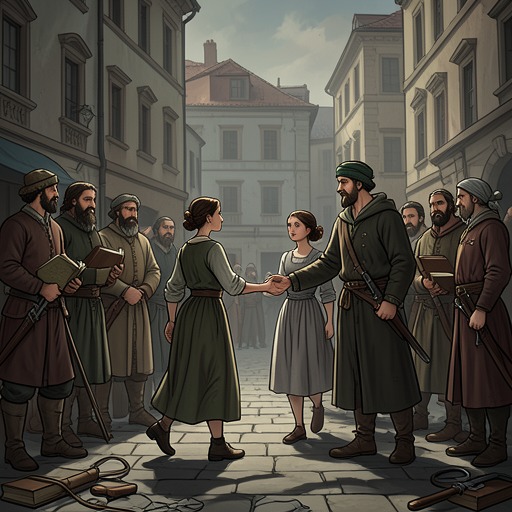
Giacomino da Pavia
The DecameronGiacomino da Pavia is a former soldier whose trustworthiness turns a deathbed bequest into the protection and eventual restoration of an orphaned girl. In Neifile’s Day Five tale, he receives Guidotto da Cremona’s daughter and worldly goods, raises her as his own, and helps bring her story to a peaceful conclusion when her birth family is found and she marries Minghino di Mingole.
Identity and Background
Giacomino is one of two Lombards, both advanced in years, who had spent much of their youth as soldiers and in deeds of arms. The other is Guidotto da Cremona, his friend and comrade. When Guidotto lies dying, he has no son, other kinsman, or friend in whom he trusts more than Giacomino; he therefore entrusts him with a little daughter, about ten years old, and everything he owns. Their history of companionship and Guidotto’s explicit confidence establish the foundation of Giacomino’s role: he is not merely the recipient of property, but the person trusted to carry a child’s care and future forward.
The circumstances of the bequest reach back to Faenza’s violent past. Guidotto had told Giacomino that, when Emperor Frederick took the city and it was given over to pillage, he and his companions entered a house full of booty. The inhabitants had fled, except for a girl of about two, who called Guidotto father as he came upstairs. He took pity on her and carried her away with the goods. On his deathbed, he told Giacomino where she had come from, charged him to marry her when the time was right, and directed him to give her the dowry that had belonged to her. The child’s origins are thus known to Giacomino well before the other characters discover them.
Guardianship and Life in Faenza
After Faenza, long afflicted by war, is again opened to those wishing to return, Giacomino goes back there with his goods and Guidotto’s ward. The girl grows up in his household, and he loves and treats her as though she were his own child. That care gives her a home after the destruction and separation of her earliest years, while Giacomino remains faithful to the charge entrusted to him.
By the time she is fifteen, she is described as fair, virtuous, and well-bred, and is courted by many. Giannole di Severino and Minghino di Mingole are the two suitors who especially compete for her; both are of equal worth and condition, and both would gladly marry her if their kinsfolk allowed it. Giacomino has not yet found an occasion to marry her that pleases him. His delay is presented as a matter of judgment about her future, not indifference: he says he would gladly arrange the marriage rather than risk another mischance concerning her.
Rivalry, Recognition, and Resolution
The young men’s rivalry grows dangerous as each tries to obtain Agnesa, including through help from servants in Giacomino’s household. Their conflict leads to an offence serious enough for Giannole, Minghino, and others involved to be imprisoned. In the aftermath, Giacomino explains the girl’s history to the gentlemen present: Guidotto had found her during the sack of Faenza and had left her in his care. That account turns an apparent dispute over a young woman’s marriage into a question of family identity and restitution.
Guiglielmino da Medicina recognizes the description as matching the house that Guidotto had plundered. Bernabuccio then recalls that he lost a little daughter of about the same age in those troubles. When he sees Agnesa, he weeps and embraces her, naming her as his daughter and explaining that she had been left behind in the sudden alarm while the family believed she had died in the burning of their house. Agnesa initially resists his embrace, but, hearing his account and seeing him to be an older man, comes to believe him and weeps with him. Her mother, siblings, and other kinswomen are summoned; Bernabuccio takes her home amid the family’s rejoicing.
Giacomino’s response confirms that guardianship has not become a claim to keep Agnesa for himself. He accepts her restoration to her birth family, and the town captain, learning that Giannole is Bernabuccio’s son and therefore Agnesa’s brother, releases the prisoners. The captain then intercedes with Bernabuccio and Giacomino, makes peace between the suitors, and gives Agnesa in marriage to Minghino with the consent of the families. Minghino celebrates a great wedding, and the couple live in peace and prosperity for many years.
Narrative Role and Significance
Giacomino links the tale’s two households and two moments of loss: the child taken from a pillaged home and the young woman returned to relatives who had believed her dead. His fidelity to Guidotto preserves both Agnesa’s upbringing and the knowledge needed to explain her origins. The final recognition does not erase the years she spent in his care; instead, his willingness to cooperate allows that care to lead into reunion rather than rivalry over possession.
The episode also makes marriage the point at which several obligations meet. Guidotto had charged Giacomino to provide a dowry and arrange a suitable match; the discovery of Agnesa’s parentage changes who can participate in that decision, while the captain’s intervention ends the suitors’ conflict and restores peace between the families. Giacomino’s part is consequential but restrained: he safeguards the bequest, tells what he knows, and accepts a resolution in which Agnesa is reunited with her birth family and married with family consent.